Monday, May 1, 2023

ETTRINGITE FROM THE KALAHARI DESERT AND YOUR SIDEWALK

Why Do You Want To Know?

A recent post on the Denver Spring Show was a generalized “here is a sampling of what I saw at the venue.” As stated in this post, I came home with only a few specimens, and one was a nicely colored group of hexagonal ettringite crystals [Ca6Al2(SO4)3(OH)12-26H2O].

Ettringite is an interesting mineral, a hydrous calcium aluminum sulfate, and is somewhat confusing to me. At the Type Locality in Rhineland-Palatinate, Germany, ettringite crystals are tiny, hexagonal, gemmy clear, and many have nice terminations with rhombohedral faces—think quartz look-a-likes. A few are even very thin, white fibers. Crystals at the TL are associated with metamorphosed limestone.

Talk to a construction/economic/chemical mineralogist and they will tell you that ettringite is a “hexacalcium aluminum trisulfate hydrate” that is formed in Portland cement as a result of the reaction of tricalcium aluminate  (C3A) with calcium sulfate (CaSO4): C3A + 3 CaSO4 → ettringite (Merlini and others, 2008). Did you ever wonder why freshly poured concrete gets warm (one of life’s persistent questions)?  The C3A hydration is very exothermic and occurs quickly in the fresh concrete mix; the temperature increases with the fast progress of the hydration reaction. The workers “in the know” (those cement chemists) then add gypsum (CaSO4·2H2O) and other materials [perhaps heated (sintered) limestone, clay, fly ash. etc.] to the Portland cement to control the concrete setting. It seems like the gypsum allows  ettringite to coat the C3A grains and slows down the hydration (Divet, 2000). WOW. I thought you simply added some sand and water to a bag of cement, mix, and presto with some time you get hard concrete!   

All of these ruminations on cement mixing bring back, from the far reaches of my mind, some unpleasant memories of a 7:30 am class on construction mineralogy (mainly taught to civil engineering students) or some such thing. Luckily, I was auditing the class and did not take the tests. That choice was a masterful stroke of genius on my part since I understood very little of what was going on, especially at 7:30 am. And finally, don’t be confused with the chemistry as those pesky cement chemists use their own chemical notations such as C=CaO and A=Al2O3! 

DON"T ASK ME HOW TO FORMAT WORD!!!!! 

Above: Ettringite crystals formed in concrete. I am guessing this is a SEM photomicrograph with the longest crystal ~ 40 microns. Credit Farnam’s Research Group at Drexel University, Drexel Advanced and Sustainable Infrastructure Materials Lab for the photo. Published in National Precast Concrete Association / Precast Magazines / Precast Inc. Magazine / 2018 – July-August


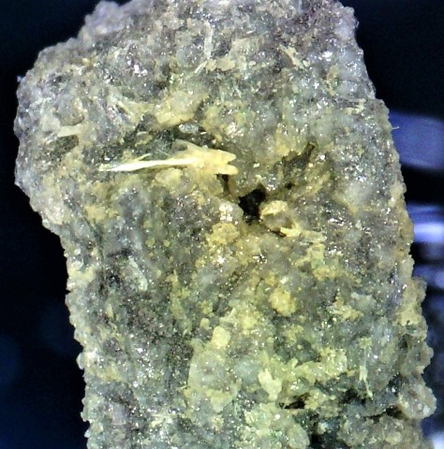
Crystals of tan to lemon-yellow ettringite/ The dark (black) material is some sort of manganese oxide, probably manganite [Mn3+O(OH)] while the chalky white mineral is most likely oyelite [Ca10Si8B2O29 · 12.5H2O]. Width FOV top ~1.6 cm, middle ~1.7 cm, bottom ~6 mm

I need to unpack some of that material from my mind and toss it in the garbage. But hold on—as a life-long learner I now know why concrete heats up when poured, and the need to spray water on fresh concrete to retard evaporation and slow down the hydration and produce stronger concrete. That little bit of learning eases my rumbling mind!!

All of this chatter leads me back to ettringite from the Denver show. Many rockhounds have nice yellow to lemon-yellow ettringite crystals in their collection and would not recognize minerals from the Type Locality nor realize that their sidewalk probably has tiny ettringite crystals. Almost all collectable ettringite crystals come from the Kalahari Manganese Field in the northern Cape Province, South Africa, especially from the N'Chwaning Mines and some from the Wessels Mine. These mines were not really operational until the 1970s and 1980s; therefore, the great mineral specimens from the mines only appeared on the market in the last 50 years or so. MinDat noted that “apart from their ore producing significance [manganese], the N'Chwaning mines are notable and famous among the mineral collecting community for producing high-quality mineral specimens of rhodochrosite, manganite, ettringite, inesite, jouravskite and other minerals. The majority of the major mineral finds documented originate from the N'Chwaning II shaft [production started in 1981]… The manganese ores of the Kalahari Manganese Field are contained within sediments of the Hotazel Formation of the Griqualand West Sequence, a subdivision of the Proterozoic Transvaal Supergroup.” These late discoveries explain why my favorite mineral book, Encyclopedia of Minerals (Roberts and others, 1974), does not mention the Kalahari ettringite.

I “want to know” since it gives me a purpose in life. It makes my life worthwhile. It is what gets me up in the morning. It keeps me healthy, happy, and hopefully creative. It pumps up my mojo.

REFERENCES CITED


Divet, Loïc, 2000, State of knowledge on the possible causes of sulfate reactions internal to concrete: Bulletin de Liaison des Laboratoires des Ponts et Chaussées, Number 227.

Merlini, M., G. Artioli, T. Cerulli, F. Cella, and A. Bravo, 2008, Tricalcium aluminate hydration in additivated systems. A crystallographic study by SR-XRPD: Cement and Concrete Research, Elsevier vol. 38, no. 4. 

Roberts, W.L., G.R. Rapp, Jr., and J. Weber, 1974, Encyclopedia of Minerals: Van Nostrand Reinhold Company, New York.


Tuesday, April 25, 2023

VALENTINITE: SECONDARY ANTIMONY MINERAL


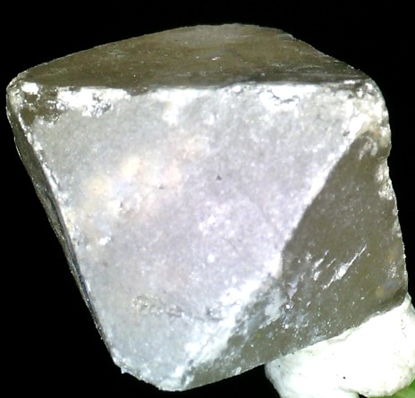
In an earlier posting (August 21, 2020) I described my specimen of senarmontite, an antimony oxide [Sb2O3] that often appears as nice octahedral crystals (Isometric System). It usually has a gray to white color or occasionally red to colorless.  The colorless variety is transparent while the others are translucent to mildly opaque.  Although my specimen is a nice octahedron, senarmontite also occurs as a massive and or granular mineral. Colorless crystals are subvitreous while others have a resinous luster, but all have a white streak.  The mineral also is quite soft at ~2 or a little more (Mohs).


The octahedron of translucent senarmontite.  Width/length crystal ~7 mm.   Specimen collected from  the Djebel Hammimat Mine, Ain Babouche District, Oum el Bouaghi Province, Algeria.

It is always interesting as a rockhound to locate dimorphous minerals, that is minerals with the same chemical formula but crystalizing in different Crystal Systems. So, I was happy to pick up two specimens of valentinite, also an antimony oxide with the same chemical formula as senarmontite [Sb2O3]. However, valentinite is a member of the Orthorhombic Crystal System and usually appears as flattened prismatic crystals with complex terminations in fan-shaped aggregates. Most minerals have an adamantine luster, a white streak, and are colorless to white; collectors like to locate rarer yellow, pink and brown crystals, However, as in senarmontite, valentinite may form in granular masses.


The specimen above was collected from the Graf Jost-Christian Mine, Wolfsberg, Sangerhausen, Mansfeld-Sudharz, Saxony-Anhalt, Germany. The mine started extracting antimony ore around 1700. There are tiny acicular crystals on porous quartz crystals. MinDat noted specimens from here are rare. The original label, from Shannon’s Minerals in Tucson was glued on but appears “older,” I remounted the specimen due to the condition of case. Width FOV top is ~9.5 mm. With of bottom specimen ~3.0 mm.


Flat lying radiating sprays of valentinite on a stibnite matrix. Width FOV ~1.7 cm. Collected from Kolarsky vrch deposit, Pezinok, Pezinok District, Bratislava Region, Slovakia. MinDat noted “One of the largest hydrothermal antimony deposits in Slovakia. Small-scale mining of antimony started in 1790 and after some breaks finally stopped in 1991 for economic reasons. The deposit is famous for excellent kermesite specimens. Vein-type antimony deposit, hosted in Late Silurian to Lower Carboniferous phyllites and black slates.”

Both senarmontite and valentinite are secondary minerals and are  weathering/alteration products of other antimony-bearing minerals (commonly stibnite) in the oxidized zone of hydrothermal antimony deposits. Associated oxidized minerals often include stibiconite [Sb3+Sb5+O6(OH)], cervantite [Sb3+Sb5+O4], and kermesite [Sb2S2O].

A brief word about dimorphic polymorphism—brief because understanding the exact mechanisms causing such are mostly above my pay grade. I best understand the dimorphs calcite and aragonite (high pressure polymorph). However, aragonite is metastable at the low pressures near the Earth's surface and is thus commonly replaced by calcite. In fact, aragonite is rare or absent in rocks older than ~Mississippian age. Many rockhounds "sort of" understand carbon (hexagonal structure) and diamond (isometric structure) where differing pressure and temperature form different minerals. I "sort of" understand that the dimorphism in senarmontite and valentinite evidently is in response to changes in temperature and pressure during their formation. Senarmontite seems to be metastable; however, I don’t have the slightest idea if  there can be a change to valentinite. I just cannot locate appropriate informative literature so will file that problem in “one of life’s persistent questions.”


Monday, April 17, 2023

READY TO BUY; READY TO SELL: DENVER 2023


I had the opportunity to attend one day, a very loooong day, of the Spring Denver show at the Crown Plaza DIA. My initial impressions were: 1) it was a very large show and I counted over 100 dealers; 2) prices continue to move upwards, just as groceries and my home utility bill; 3)  the Friday show attracted a large crowd. 

I came home with only a few specimens and will post them in the near future. However, I did want to throw out a few photos of the show.


Ready to buy at the opening bell!!!!
Ready to sell, let them in!!!!

Boxes of attractive shattuckite, a copper silicate [Cu5(Si2)6)2(OH)2 ] from Democratic Republic of Congo (boxes are labeled Zaire). Most are in the $200 range.
Not many minerals to excite here, just playing tunes on the metal bowls. Not for me as I flunked finger cymbals in the grade school rhythm band.
Hematite included quartz from Morocco, Dan & Barb Stephens. 
$100.
Halite from Searls Lake, CA.  Dan & Barb Stephens. 
$125.

Dennis Beals of Colorado (Denver area)  had this beautiful specimen of calcite from Santa Eulalia, Mexico. Dennis is always good for a wild tale or two about his southern collecting trips. 

Binghamite  is a lapidary term referring to a rock consisting of fibrous amphiboles intergrown with quartz. The amphiboles are mostly altered to a complex mix of quartz, siderite, and various iron and manganese oxides such as hematite and goethite. Rough material comes from the iron range mines in Crow Wing County, Minnesota. Info from MinDat.

Phil from Persson Rare Minerals (Denver area) sorting out his display case. Nice specimens.
Do you like earrings? I saw several displays such as these faceted  minerals (maybe some synthetics?)

Nice displays of fossils. Read an interesting article about selling vertebrate fossils collected in China at https://www.fossilhunters.xyz/ (updated April 15th, 2023).

Boxes and boxes of pretty minerals flooded the floor.

Maybe the most reasonable price all day on faceted stones.

Tourmaline Group (mostly elbaite) specimens for sale at many booths.
I always like polished labradorite with the iridescent effects. Usually out of my price range!
As usual, the "guard" at the gate would not let me sweet talk my way into the Wholesale Section of the Show where Dan's Used Rocks was hiding.


Colorado Springs dealers Joe Dorris (Pinnacle 5 Minerals) and Leonard Himes never miss a show. My photo of Austin and Kevin from the Springs turned into a big blur. Sorry.
And if all those faceted gems and semi-gems did not get you excited, there were always magic minerals to peruse. External of the show one might be able to buy magic weed and perhaps scrounge up some magic shrooms--after all this is Colorado, a pretty magic place to live. Travelers, just remember to clean out your luggage before flying home 😁😁😁


Saturday, March 18, 2023

IT'S THAT DANG CUROSITY AGAIN: THE SULFARSENIDE COBALTITE

The important thing is not to stop questioning. Curiosity has its own reason for existing.    Einstein

In my last posting on rouxelite I noted the mineral was a member of the Sulfide Class, minerals containing either the sulfide anion S2-or the disulfide anion S22-, that is either one or two sulfur ions, each with an oxidation state of 2 minus (2--). The formula is often written as AmSn where A is a metal, often iron, copper nickel, lead, silver or zinc, S is sulfur, and m and n are numbers indicating cations /anions present. Most rockhounds will recognize the iron sulfide mineral, pyrite—FeS2. (one iron cation and two sulfur (a disulfide) anions. Or perhaps galena, the lead sulfide PbS—one lead cation and one sulfur anion.

One of the more interesting and complex group of sulfides are the sulfosalts. These minerals contain: 1) a metal (mostly lead, copper, iron or silver although a few others, mercury, zinc, vanadium may be present); 2) a semi-metal like arsenic, germanium, antimony, or the post-transitional metal bismuth, or the metals tin or vanadium’ and 3) sulfur but perhaps selenium or tellurium (Richards, 1999). In case you are wondering, semi-metals are elements with properties both of a metal and of a non-metal and are the following: boron, silicon, germanium, polonium, arsenic, antimony, tellurium, and tennessine (radioactive, artificially produced element).  All are interesting elements: each semi-metal takes several different forms (allotropes), but all have at least one form that is shiny and metallic looking.  All are solid at room temperature and pressure, and act as nonmetals in chemical reactions. They are poor conductors of electricity (unlike metals) but make excellent semiconductors. Most are malleable and some are ductile, Semi-metals can form alloys with metals and a lead-antimony combination is an important industrial component of batteries and cable sheaths. Most semi-metals are rarely found in the natural state but are common in combination with other elements. For example, silicon is the second most abundant element on our earth (after oxygen) but does not occur uncombined in nature. So, these are the semi-metals and sulfosalts. Interesting? Yes! 

The sulfarsenide minerals are also a group of sulfides with metal(s) plus semi-metal(s) plus sulfur and therefore must seem related to the sulfosalts. However, there is a big difference in the two groups in that the semi-metal arsenic has moved from a positively charged cation to replacing some of the sulfur as a negatively charged anion as in the minerals arsenopyrite [FeAsS] and cobaltite [CoAsS]. These minerals confuse me (not hard) since I did not realize that both sulfur and arsenic may have oxidation states of 1 minus so cobaltite is Co2+, S1- and As1- . Because the −1 oxidation states for S and As are not stable in solution, the mineral reactions always involve oxidation of the S and As to some higher oxidation state in order to be released into solution (https://chem.libretexts.org/). 

I recently acquired a couple of micromounts of cobaltite that exhibit really nice crystals. One specimen is from Håkansboda, Bergslagen Mining District, Sweden, and was, at one time in the collection of Al Kidwell (he of kidwellite fame—see Posting July 7, 2015). As best I can determine the stratigraphy of Bergslagen [part of a Precambrian Shield] is quite complex with original volcanic and sedimentary rocks of Precambrian age [1.8-1.9 Ga] intruded by granite, folded and faulted, and then invaded by hydrothermally emplaced sulfides (pyrite, chalcopyrite, sphalerite, and galena) when the hot fluid interacted with carbonates and mixed with cool seawater in a seafloor environment (Kampmann and others, 2017).

Håkansboda is a very old mining district (at least to U.S. standards) and started some time in the 1400s but was never a large producer (Falun was the 800 pound gorilla in the region—see Posting July 1, 2020. Tegengren (1914 in MinDat) noted that total copper production from 1613 until 1905 was about 2100 tons with 7 tons of cobalt during 1836-1841. Currently the Håkansboda ore field is under intensive investigations and has shown good potential for copper, cobalt, iron, zinc, lead, silver, nickel, and potentially REE’s (Månbro, 2021). Although most cobalt production was as a byproduct of copper mining, some cobaltite ore is present and has produced many of the finest crystals in the world.

Cobaltite crystal. Width of crystal ~1.5 mm.

The second micro was collected by a J. Seguin in Ontario, Canada, and mounted in 1973 by Art Smith. I could not locate good information on Seguin and I presume the crystal was collected from the most famous locality in the Cobalt/Sudbury, Ontario, Mining District, the “Brazil Lake occurrence.” According to Sabina (1991) cobaltite euhedral crystals measuring up to 3 cm in diameter occur with actinolite amphibolite along the walls of a quartz-dolomite calcite vein containing pyrrhotite and chalcopyrite.

Cobaltite crystals on a micromount stand. Width FOV ~6 mm.

 The Cobalt, Ontario, portion of the District is located northeast of the town of Sudbury and regardless of its name, silver was the major metallic commodity. At one time in the early 1900s the Cobalt area mines were the world’s largest producer of silver and total production over the years totaled nearly a thousand tons.  The silver was associated with nickel and arsenic minerals like skutterudite.

I was unable to locate exact production figures of cobalt and nickel for the Cobalt area; however, Young and Perrone (2013) noted that “small high-grade deposits of nickel-cobalt arsenides furnish significant quantities of cobalt. Arsenide ores from Cobalt, Ontario, gave Canada world leadership in production for the period 1905-25. Cobalt output from this area stopped in 1971 but was reactivated in 1995 as a primary production center and now seems a major producer.

 Pink cobalt bloom (erythrite) on specimen from Cobalt, Ontario, Canada.  Width FOV ~7 mm.

Cobalt is a critical mineral in today’s high-tech and electronic world, especially for use in rechargeable batteries, to strengthen steel and other metals, and to construct rare-earth magnets. In the latter use cobalt is combined with samarium (SmCo) to create magnets with  good temperature stability and a strong resistance to corrosion. In regards to batteries, the public always hears about the need for lithium; however, cobalt, nickel, and graphite are also critical components.

Although cobalt is present as a component in many minerals, most cobalt-containing ores are mined for other minerals such as gold, zinc, silver, lead, copper, and nickel. The cobalt is then harvested as a by-product.

Most cobalt on the market comes from the mining of: 1) nickel/cobalt ores of chalcopyrite, pyrrhotite, pentlandite (nickel, iron sulfide), cobaltite and others. Pentlandite is the major nickel sulfide although other minerals on the list often contain smaller amounts. The major mines of these magmatic sulfide deposits include Noril’sk-Talnakh (Russia), Sudbury (Canada), and Kambalda (Australia); 2) copper/cobalt ores from the Central African Copper belt in the Democratic Republic of the Congo and neighboring Zambia. Here cobalt deposits usually consist of two layers: a) weathered “oxide” surface containing mainly heterogenite CoO(OH);  and b) unweathered Cu,Co “sulfide” deposits below these “oxide” caps containing mainly carrollite Co2CuS4.


The photomicrograph does not do justice to the mirror faces of this altered cube, maybe a cubo-octahedron., of carrollite (C). A gemmy poker chip of calcite (Ca) is attached at lower right.  The calcite rhombs (CA) form the matrix.  I don't have the slightest idea what the small green crystals (?) scattered on the matrix represent. Width of carrollite crystal ~3.2 mm.

A third major source of cobalt is the Moroccan cobalt–arsenic ores in the Bou-Azzer deposit, about the only mines in the world where cobalt is produced as a primary product.  Here the major cobalt producing minerals are skutterudite (CoAs3 or (Co,Fe,Ni)As2-3) and erythrite (Co3(AsO4)2 · 8H2O).

Specimen of Specimen of skutterudite from Morocco with nice octahedral crystals on fresh surface. The majority of the surface, bottom and sides of specimen, is massive and granular.  White mineral is calcite.  Specimen is difficult to photograph as bright metallic luster reflects light.  Length of specimen ~4 cm.


Photomicrograph clusters of erythrite sheaths from Bou Azzer.

Minor sources of cobalt come from nickel-cobalt laterite deposits where enrichments of Ni-Co from from intense chemical and mechanical weathering of ultramafic parent rocks such as dunite and “serpentinite.” The major lateritic mines operating today are in New Caledonia, a French Territory in the South Pacific. Future cobalt resources might come from manganese nodules and cobalt-rich crust on ocean seafloors.

OK, so cobalt is a valuable component needed for batteries in electric vehicles, now what? In reading about cobalt resources, I noted there are serious concerns about child labor and environmental contamination in the Central African Co/Ni Belt. Sudbury and the Canadian Cobalt Belt have faced serious environmental disasters in the past and problems still exist. The U.S Congress would like to source critical minerals from countries other than China and Russia; however, obtaining mining permits in the U.S is a multi-year task, and perhaps with good reason!

The only major cobalt mine in the lower 48 was the Blackbird Mine near Challis, and Cobalt, Idaho. The Blackbird closed in the early 1980s after more than 30 years of intermittent operations. By then, the surrounding creeks were lifeless; heavy-metal pollution had killed off most of their fish and aquatic insects.  Today, the 10,830-acre Mine is now a toxic waste site. The Superfund Site includes a 12-acre open pit, 4.8 million tons of waste rock, 2 million tons of tailings, and enough tunnels that, if they were strung together, you could run a half marathon in them and still have nearly a mile to spare. Over the past 26 years, the Blackbird Mine Site Group has restored creeks, sealed off mine portals, and constructed an intricate system of ponds and ditches designed to separate clean water from contaminated water. The end date for restoration is unknown; however, in the early 2000s, Chinook salmon returned to nearby Panther Creek. (Holtz, 2022).

The Blackbird sits in the Idaho Cobalt Belt, a 34-mile-long area in the Salmon-Challis National Forest that contains some of the largest cobalt deposits in the country. As the global market for lithium-ion batteries has grown—and the price of cobalt along with it—so has commercial interest in the belt. At least six mining companies have applied for permits from the U.S. Forest Service to operate in the region. Most of these companies are in the early stages of exploration; one has started to build a mine (Holtz, 2022).

The US Geological Survey has spent decades studying the cobalt belt and noted the belt is an alignment of deposits composed of cobaltite, cobaltiferous pyrite, pyrrhotite, arsenopyrite, chalcopyrite, and gold with anomalous rare-earth elements in a quartz-biotite-tourmaline gangue hosted in Mesoproterozoic metasedimentary rocks of the Lemhi Group.

I have a small specimen (toenail) purchased from a now defunct rock/mineral store over two decades ago. It has an older label stating “cobaltite, Cobalt, Idaho.” Good photos of Idaho cobalt seem tough to locate. The photo below seems to indicate cobaltite, arsenopyrite, and chalcopyrite.


Specimen of cobalt-bearing minerals from Cobalt, Idaho. Width FOV ~6 mm.
 

Several years ago, maybe in the early 1980s/late 1970s, I spent a few days up in the Salmon-Challis National Forest near Challis trying to clear a site (look for fossils) for a possible fluorite mine. I don’t remember much except it was in the Bayhorse Mining District, a fantastic “Ghost Town” was well preserved, and the only fossils I could locate were Ordovician? graptolites. I never found out if the mine was permitted.

In news from Canada, I read in Mining.com about New road paves the way for Canada’s first primary cobalt mine. “Evidently a new paved road has been constructed to the NICO deposit in Canada’s Northwest Territories that was discovered by Fortune Minerals in 1996. NICO is a fully vertically integrated project that will include mining and concentrating ores in the Northwest Territories, and transportation of the metal concentrate to the proposed refinery in Alberta for further processing to high value metal and chemical products. NICO is positioned to stand out as a North American asset dedicated to the production of cobalt chemicals needed to manufacture rechargeable batteries used in electric vehicles, stationary power storage applications, and portable electronics such as smart phones, tablets and laptops. The unique metal assemblage of the deposit also includes more than 10% of global bismuth reserves along with significant gold as a counter cyclical hedge to reduce exposure to cobalt and bismuth price volatility.”

So, if you are investor (probably younger) who likes to take chances with your money, consider cobalt or lithium or one of the REEs. At my age any “extra” resources (as if there is any) goes into U.S. Treasury Bills or Notes. The boys and girls in Washington better not default on the budget!!!

REFERENCES CITED

Holtz, M., 2022, Idaho Is Sitting on One of the Most Important Elements on Earth: The Atlantic https://www.theatlantic.com/science/archive/2022/01/cobalt-clean-energy-climate-change-idaho/621321/

Månbro, C., 2021, The Geology and Geochemistry of the Håkansboda Cu-Co deposit, Bergslagen, Sweden: M.S. Thesis, Stockholm University.

Kampmann, T., Jansson, N., Stephens, M., Majka, J., Lasskogen, J., 2017, Systematics of Hydrothermal Alteration at the Falun Base Metal Sulfide Deposit and Implications for Ore Genesis and Exploration, Bergslagen Ore District, Fennoscandian Shield, Sweden: Economic Geology v. 112, no. 5.

Sabina, A.P.,1991, Rocks and Minerals for the Collector: Sudbury to Winnipeg. Geological Survey of Canada Miscellaneous Report 49: https://geoscan.nrcan.gc.ca/starweb/geoscan/servlet.starweb?path=geoscan/fulle.web&search1=R=132238

Tegengren, F.,1924, (in MinDat): Sveriges ädlare malmer och bergverk (in Swedish). SGU ser Ca17, Stockholm.

Young, R.S. and L. Perrone, 2013, Cobalt:  www.thecanadianencyclopedia.ca

My non-investing advice: The most important thing is to live an interesting life. Keep your eyes, ears and heart open. Talk to people and visit interesting places, and don't forget to ask questions. Drink in the world around you so it's always there in your head.      Michael Morpurgo

Saturday, March 4, 2023

CURIOSITY GOT TO ME: THE COPPER MERCURY LEAD SULFOSALT ROUXELITE

Curiosity is the wick in the candle of learning.      W.A. Ward

The sulfosalt minerals, members of the sulfide group (sulfur is the major anion), are quite complex minerals, at least to an ole plugger like me. In a couple of previous posts, I “described” cylindrite (FePb3Sn4Sb2S14) on 1/23/17 and dufrènoysite [Pb2As2S5] on 6/19/19. Sulfosalts contain a metal (mostly lead, copper, iron or silver although a few others, mercury, zinc, vanadium may be present), a semi-metal like arsenic, germanium, bismuth, antimony, or the metals tin or vanadium, and then sulfur but perhaps selenium or tellurium (Richards, 1999).

At 2022 Tucson I had several good conversations with a European dealer on some slow days and learned much. He also pulled out of his collection a specimen of rouxelite and noted that this mineral was quite rare and was only described in 2005. I looked at the micro through a loupe and it was a gorgeous mineral and so I brought it home.


Rouxelite crystals from the Sant’Olga tunnel, Monte Arsiccio Mine. The longer whiskers are ~ 2 mm in length.

Crystals of rouxelite [Cu2HgPb23Sb27S65.5 ] are acicular, elongated and striated, black in color but at times with a bluish violet iridescence, and have a metallic luster. They belong to the Monoclinic Crystal System, Prismatic Class. MinDat noted that the hardness of rouxelite could not be measured, and no cleavage was observed. The Handbook of Mineralogy.org also noted that some rouxelite from the TL contains thallium, silver, arsenic and bismuth.

The Type Specimen of rouxelite is from the Buca della Vena mine, Apuan Alps, Tuscany Italy, where it actually is quite rare. The mine is a small Fe–Ba deposit in the Apuan Alps  and represents a complex mineralogy (no mining past 1988). Many lead–antimony sulfosalts have been collected from the mine (79 valid minerals including 14 Types). Like the other lead sulfosalts, rouxelite was formed in the latest stage of hydrothermal activity, within small veinlets cross-cutting dolomitic lenses interstratified in the Ba–Fe ore (Orlandi and others, 2005). Distribution of rouxelite in Tuscany is limited to an area from the Buca della Vena Fe-Ba deposit, near the village of Ponte Stazzemese, then extending about 11 km southwest to the Sant’Olga tunnel, Monte Arsiccio mine, near Sant'Anna di Stazzema. The only other know specimens are from the Magurka antimony deposit, Slovakia. Indeed, it is a rare mineral (www.handbookofmineralogy.org/pdfs/rouxelite.pdf).

My specimen came from the St. Olga Tunnel which is, to the best of my knowledge, an opening into the Monte Arsiccio Mine. The mine was the economically the most important pyrite ± baryte ± iron oxide deposit in the Apuan Alps. The orebodies are hosted within a Paleozoic metavolcanic–metasedimentary sequence, locally tourmalinized, close to the contact with the overlying Triassic metadolostone (“Grezzoni” Formation), belonging to the Apuane Unit (D’Orazio and others, 2021).

The rouxelite from the Monte Arsiccio Mine (72 valid minerals including 13 types) was the most recent locality described (Biagioni and others, 2014). Perhaps the most interesting aspect of this locality is that electronic gizmos (Inductively Coupled Plasma Mass Spectrometry) show there is a widespread substitution of Hg (mercury) by Ag (silver) and some incorporation of Tl (thallium) with the silver and therefore is a new example of a thallium sulfosalt (D'Orazio and others, 2021). This seemingly obscure notation may be important since thallium is a highly toxic metal associated with low-temperature hydrothermal mineralization. Weathering and oxidation of sulfides (including sulfosalts) may generate acid drainage with a high concentration of thallium and may pose a threat to surrounding environments.

At the end of this little exercise on a rare and complex mineral the question is—why learn about rouxelite? Well, to quote B.B. King, The beautiful thing about learning is that no one can take it away from you.

.  

REFERENCES CITED

Biagioni, C., Y. Moelo, and P. Orlandi, Paolo, 2014. Lead-antimony sulfosalts from Tuscany (Italy). XV. (Tl-Ag)-bearing rouxelite from Monte Arsiccio mine: Occurrence and crystal chemistry. Mineralogical Magazine. Vol. 78.

D’Orazio, M.; Mauro, D.; Valerio, M.; Biagioni, C., 2021, Secondary Sulfates from the Monte Arsiccio Mine (Apuan Alps, Tuscany, Italy): Trace-Element Budget and Role in the Formation of Acid Mine Drainage: Minerals, vol. 11, no. 2.

Orlandi P, Meerschaut A, Moelo Y, Palvadeau P, Leone P, 2005, Lead-antimony sulfosalts from Tuscany (Italy). VIII. Rouxelite, Cu2HgPb22Sb28S64(O,S)2, A new sulfosalt from Buca Della Vena mine, Apuan Alps: definition and crystal structure The Canadian Mineralogist 43 919-933.

Richards, J.P., 1999, Encyclopedia of Geochemistry in Encyclopedia of Earth Sciences Series, C.P Marshall and R.W. Fairbridge, eds.: Springer Netherlands.

Zhao, F. and S. Gu, 2021, Secondary sulfate minerals from thallium mineralized areas: Their formation and environmental significance: Minerals, vol. 11, no. 8.