Does it really contain bismuth? Yep. Bismuth can be used in making scents! Pepto Bismo™
Bismuth (Bi) is a metallic element (Atomic Number 83)
that has many chemical and physical properties that resemble antimony and
arsenic. Although most/many people probably recognize the name bismuth they know
very little about the element except that “pink-colored” bismuth (bismuth
subsalicylate; C7H5BiO4) is an anti-diarrhea
OTC medicine. Waterfowl hunters probably realize that bismuth (86% the density
of lead and low metal toxicity) shot is a substitute for lead shot (to prevent
lead poisoning) and fishers often use bismuth-based weights for the same reason. Rockhounds
and others who attend rock and mineral shows are often exposed to nice hoppered
bismuth crystals covered with a rainbow of iridescent colors. These crystals
are not “natural” and are synthetic.
Hoppered synthetic bismuth crystal from Wikipedia attributed to: Alchemist-hp (www.pse-mendelejew.de) + Richard Bartz
Natural bismuth is extremely difficult for
an ole plugger like me to identify. [Don't be afraid to be confused. Try to remain permanently confused. Anything is possible! G. Saunders]. It rarely occurs as crystals but if so, are
often trigonal, reddish white to creamy white tarnished to iridescent pink or yellow and have a metallic luster and a silver streak. Bismuth can be massive
and very “dark” in color due to a tarnish. Perhaps the most common habit is
foliated and parallel crystals or crystal fragments since it has perfect
cleavage. MinDat noted that bismuth occurs in “hydrothermal veins with ores of
Co, Ni, Ag, and Sn; in pegmatites and topaz-bearing Sn–W quartz veins.” It is
just a tough mineral to ID in rocks unless one is specifically expecting it’s
presence.
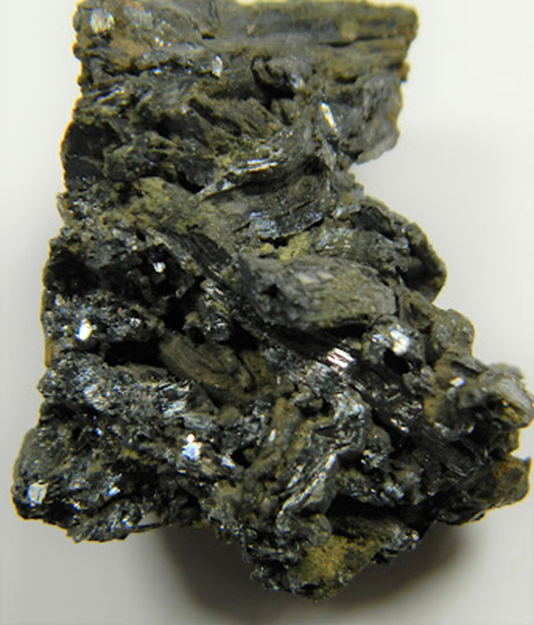
As best that I can determine this is natural bismuth from the Rubicon Pegmatite in Namibia. Wirth FOV ~1 cm.
The IMS recognizes 128 valid minerals that contain
bismuth and sulfur (MinDat, July 21, 2023). The most common sulfide is
bismuthinite [Bi2O3], a major ore of bismuth. It is a very soft mineral [~2.5 Mohs], has a
metallic luster with a lead gray to while color, and is opaque. The mineral
crystalizes in the Orthorhombic System, but most specimens appear as long
prismatic to slender acicular crystals that are often flexible. With weathering an iridescent tarnish usually
is noted. The crystals are often
mistaken for stibnite (Trigonal Crystal System) to which it is related via
solid solution—the bismuth being replaced by antimony. In addition,
bismuthinite forms a series with aikinite, a lead, copper bismuth sulfide.
Bismuthinite, from the famous mines in Bolivia, formed in high-temperature
hydrothermal vein deposit or tourmaline-bearing copper veins associated with
granite.
|
|
|
Bismuthinite, with some marcasite coating, collected from
Farralion Viejo Mine, Cerro Tazna, Bolivia. Width FOV ~ 2.8 cm.
|
|
|
|

Uber reflective partial crystals of bismuthinite.
Non-reflective crystals with a covering of marcasite. Width FOV ~1.2 cm.
Bismutite, a carbonate [Bi2(CO2)O2],
is an uncommon mineral and an oxidation product of bismuth sulfide minerals
such as bismuthinite. My specimen came
from Rio Arriba, County, New Mexico, where pegmatites have been mined (mostly
for Rare Earth Elements and thorium) from granites of Precambrian age in the
Pteaca District. I presume the bismutite is simply a non-important secondary
mineral.
Bismutite is a pretty non-descript mineral, at least
to me, as the luster ranges from vitreous to dull and the color yellow to
black. Most specimens I have observed, including
mine, are yellow-tan earthy mats or plates without observable crystal
structures. However, it does have a gray
streak and is quite soft ~3.0 Mohs).
Probably the only way that I might recognize bismutite would be to
realize that the hypogene sulfide bismuthinite was present in the deposit.
|
|
|
Yellow fibrous and crystalline bismutite. Width of
photomicrograph ~1.7 cm.
|
|
At the 2016 Tucson Show I was rummaging through some vendor
minerals toward closing time and came upon a specimen of pottsite. Pottsite
is a quite rare hydrated (H2O) lead and bismuth vanadate [(Pb3Bi)Bi(VO4)4-H2O]
found in the oxide zones of tungsten-bearing rocks. MinDat noted
that pottsite is the only natural lead-bismuth vanadate known. The
Pb/Bi ratio varies from0.86 to 1.48. At the rock and mineral shows that I
frequent pottsite is not a common mineral for sale as the mineral has only been
found in five localities (MinDat): Cordoba, Argentina; Bavaria, Germany; USA
California, and Nevada, (Churchill and Lander counties). It seems as
if most of the collected specimens come from the type locality, the Linka Mine,
Spencer Hot Springs District in Lander County. The major target at
the Linka was tungsten with slight recovery of copper and molybdenum. Sherlock
and others (1996) defined the Spencer Hot Springs District as a “Tungsten
Skarn” where scheelite-bearing [calcium tungstate], calc-silicate rocks are
formed at boundaries of hot magma bodies (a granodiorite at Linka) and
carbonate rocks. The hot fluids dissolve some of the carbonate rocks
(a process of metamorphism called metasomatism) and deposit a wide variety of
minerals dependent upon the composition of the hydrothermal
fluid. Evidently at the Spencer Hots Springs District, tungsten was
a major component of the fluids along with secondary? lead, vanadium and
bismuth. I remain uncertain as to the rareness of combining lead and
bismuth.

The bright yellow material is submilimeter prismatic to stubby crystals of yellow pottsite. The globular orange mineral is likely clinobisvanite. The chalky white mineral may be bismutite that lost the copper component?
Clinobisvanite [Bi(VO)4] is an interesting
mineral for several reasons, but especially for the derivation of its name: crystallographic
symmetry (monoCLINic) and composition, containing BISmuth and VANadium. It
often occurs with pottsite (see above) and in microscopic form is quite
difficult for rockhounds like me to distinguish between. I often confuse the tiny
“pseudo-tetragonal crystals” of clinobisvanite with the “bipyramids or stubby
prisms terminated by pyramids” of pottsite (as described by MinDat). Pottsite
is usually bright yellow; however, an orange coating may be present.
Clinobisvanite is yellow, yellow-orange,
pale orange, or deep reddish orange in color. Often clinobisvanite occurs as
platy or globular aggregates.
Orange to yellow orange clinovisbanite and more pale yellow pottsite from the Linka Mine, Lander County, Wyoming.
There is another bismuth vanadate thrown into the mix
and that is pucherite [Bi(VO4)]. At first glance pucherite may “look like” it’s
more common relative vanadinite. My specimen has the same reddish brown to
yellowish brown color; however, the well-defined crystals with sharp angles do
not have the hexagonal barrel shape of vanadinite but are tabular to equant and
sometimes prismatic. They have a vitreous to adamantine luster, are
fairly soft with a hardness of 4 (Mohs), a distinctive yellow streak, a
conchoidal fracture and are transparent to translucent. Pucherite and
clinobisvanite, at times, occur together such as in one of my specimens from Namibia.
In fact, when reading the literature, I
noted that at some localities these two minerals are often confused and with
the advent of electronic gizmos the names have been reversed. So what I need is
a variety of spectroscopes for Frost and others (2006) stated “both Raman and
infrared spectroscopy have been used to characterise the three phase-related
minerals—dreyerite (tetragonal BiVO4), pucherite (orthorhombic BiVO4)
and clinobisvanite (monoclinic BiVO4)—and a comparison of the
spectra is made with that of the minerals namibite (Cu(BiO2)VO4(OH)),
schumacherite (Bi3O(OH)(VO4)2) and pottsite
(PbBiH(VO4)2·2H2O)… Raman
spectroscopy enables new insights into the chemistry of these bismuth vanadate
minerals. Raman spectroscopy enables the identification of the bismuth vanadate
minerals in mineral matrices where paragenetic relationships exist between the
minerals.”

Reddish brown submillimeter crystals of pucherite. Width FOV, top ~1.0 cm, bottom ~5 mm.
Somehow, I acquired another bismuth mineral for my
collection: preisingerite [Bi3(AsO4)2O(OH)] is
a rare anhydrous bismuth arsenate found as a secondary mineral in the oxidized
zone of some arsenic-bearing hydrothermal mineral deposits. The mineral seems to appear in a variety of
colors and habits. Although MinDat seems to favor colors of white to gray to
straw yellow, most of their photos, and my specimen, produce green to olive
green, rounded to tabular to rhombohedral crystals and crusts. Specimens have a
sub adamantine luster, sometimes with a conchoidal fracture, and a measured
hardness of 3-4 (Mohs).
Poorly formed green crust on quartz matrix (top) while bottom three photomicrographs show poorly formed green crystals. All are small as the width FOV is ~4mm
Preisingerite, pucherite, and clinobisvanite are well
known from the Pucher Shaft,
Wolfgang Maaßen Mine field, Schneeberg, Erzgebirgskreis, Saxony, Germany. MinDat.org
noted the area is a polymetallic deposit (Ag-Bi-Co-Ni-U-bearing veins),
was worked for silver and bismuth since the 15th century, later for cobalt and,
in the 20th century, for uranium. Most of the veins are hydrothermally formed.
The rocks in the field are early Paleozoic and late Precambrian metamorphosed
igneous and sedimentary rocks that were intruded by late Paleozoic granitic
rocks. All of this tectonic activity was a geologic
mountain-building event caused by the collision of Gondwana and Eurasia to form
the supercontinent of Pangaea. These minerals are rare alteration product of
other bismuth minerals in the oxidized zone of hydrothermal ore deposits.
Mixite "tuffs" and rosasite "balls" collected from the Carissa Mine, Tintic Mining District, Utah. Width FOV ~ 1 cm.
The most interesting bismuth specimen in my small
collection is mixite, a rare copper bismuth arsenate [BiCu6(AsO4)3(OH)6
· H2O]. Essentially a micromineral, mixite occurs as very tiny,
slender acicular needles that often congregate together in tuffs or radial
sprays. Although the crystals are usually some shades of green to blue-green,
occasionally they are white to light blue. Individuals appear to
have an adamantine luster although this is a difficult call. The tuffs are more
silky in nature. Crystals belong to the Hexagonal System and appear to be translucent
to transparent. Hardness is listed as 3.5-4 although that is tough
for me to determine. Mixite is a secondary mineral found in oxidation zones of
copper-bismuth deposits.
It is best for me to retire from looking at bismuth minerals--unless someone wants to teach me the intricacies of operating Raman and Infrared Spectrometers! I am confused!
People just want to know they are not alone being confused! (J. Ames). So good. Be confused. Confusion is where inspiration come from! (R. Mundel).
REFERENCES
CITED
Frost, R. L., D.A. Henry, M.L. Weier, and W. Martens, 2006,
Raman spectroscopy of three polymorphs of BiVO4: clinobisvanite,
dreyerite and pucherite, with comparisons to (VO4)3-bearing
minerals: namibite, pottsite and schumacherite: Journal of Raman Spectography,
Vol. 37, Issue 7.
Sherlock, M.G., D.P. Cox, and D.F. Huber, 1996, Known
mineral deposits and occurrences in Nevada: in Chapter 10 from
Nevada Bureau of Mines and Geology Open-File Report 96-2: An analysis of
Nevada's metal-bearing mineral resources): www.Nnsa.energy.gov/sites/dsfault/files/nnsa/imlinefiles