The Black Hills of South Dakota represent an elliptical uplifted
dome elongated in a north-south direction (as seen in the diagram by A.N.
Strahler). Structurally, the Hills represent the easternmost uplift of the
Laramide Rocky Mountains, perhaps 120 miles east of the Rocky Mountains in
Wyoming. However, physiographically they are part of the Great Plains Province.
The core of the Hills is composed of Proterozoic igneous and metamorphic rocks
that were uncovered during Laramide and later Tertiary uplifting events, and
then subjected to erosion. Surrounding the core are a variety of Paleozoic,
Mesozoic, and Cenozoic rocks and sediments.
When visitors flock to the Black Hills they most often
arrive to take in the scenery at and near Mt, Rushmore National Monument in the
central and southern Hills. The presidential carvings are in the ~1.715 Ga
Harney Peak Granite, essentially the youngest Precambrian rock in the Hills.
Surrounding this igneous intrusive granite is a large band of associated metamorphic
rocks and pegmatites with similar radiometric dates. The pegmatites, perhaps as
many as 24,000 units, occur within an area of about 275 square miles around
Harney Peak and range from a few inches to more than a mile in length and up to
500 feet wide. Rocks within the pegmatites are primarily plagioclase feldspars
(oligoclase and albite), potash feldspars (perthite and microcline), and
quartz. Spodumene, lepidolite, muscovite, and tourmaline are major constituents
in a few pegmatites (Redden and DeWitt, 2008).
The northern Hills seem to have a more complex and varied
hard rock geology with a few Precambrian rocks older than 2.5 Ga and Archean in
age, and mid-Tertiary intrusions. The northern metamorphic rocks also contain a
wider variety of sedimentary and igneous protoliths than the southern Hills.
I have looked at these metamorphic and igneous rocks, off
and on, for over 55 years and don’t pretend to understand much at all. There is
a reason that I settled on studying soft rocks and fossils! Redden and DeWitt
(2008), in their amazing geologic map of the Black Hills, summarized the area: “…the
Harney Peak Granite and associated pegmatites represent a complex system
involving repeated magmatic emplacement…and metamorphism. Likely these
processes extended over a considerable period of time.”
Although most rockhounds exploring the Black Hills
concentrate on pounding the pegmatites, there are several minerals in Hills that
are unique to metamorphic rocks. These
minerals and rocks formed when the original protoliths underwent changes in
chemistry and/or texture and/or composition. These changes are usually due to
heat, pressure, and hot metamorphic fluids. Petrologists, then, are able to
identify different metamorphic rocks by their distinctive mineral composition
and texture.
Another interesting aspect of metamorphic minerals is that
since many are stable only within certain limits, the presence of specific minerals
in metamorphic rocks indicates the approximate temperatures and pressures at
which the rock underwent metamorphism. The diagram below came from the Open Mineralogy
textbook and illustrates that chlorite, muscovite, biotite, andalusite, garnet
(some types of each), cordierite, staurolite, kyanite, and sillimanite are
metamorphic index minerals that indicate the approximate temperatures at which
these minerals are stable. In the metamorphic rocks west and northwest of
Custer collectable minerals (at least that I can identify) occur in schists and
gneisses of medium to high grade temperatures. Redden and Dewitt (2008 and
references therein) in some of their mapping indicated that many of the zones mineral
overlap, especially staurolite-sillimanite, something that can be noted in the
diagram. Essentially, the closer one gets to the Harney Peak Granite the higher
the metamorphic grade becomes.

Metamorphic minerals help identify
metamorphic facies, zones where specific minerals indicate the temperature and
pressure of metamorphism. Chart accessed 2023 from: https://opengeology.org/Mineralogy/8-metamorphic-minerals-and-metamorphic-rocks/
THE BLACK HILLS MINERALS—a few
Andalusite is an aluminum silicate [Al2SiO5]
that forms under low metamorphic pressure and and low to high temperatures
although it is most common in medium temperatures (see chart). Andalustite is a
polymorph (same chemical composition but different crystal structure) of
kyanite and sillimanite. Each of these three minerals form under different
temperature and pressure conditions and therefore help to identify T/P in their
host rocks. The phase diagram below is reprinted in virtually every mineralogy
and petrology textbook and comes from the Open Source Mineralogy.

Andalusite belongs to the Orthorhombic
Crystal System and often appears as columnar aggragates with individuals having
a square cross-section. I would call it opaque but thin, cut sections may be
translucent. Most field specimens are close to pink to red-brown in color, but
more gemmy specimens may occur in a variety of “brighter” colors. Although
MinDat lists a vitreous to greasy luster, most specimens I have seen have a
more subdued luster. My major means of identifying adalusite is the square
cross-section, and its mineral associations; however, andalusite is often
pseudomorphosed to other minerals, due to changes in presssure and/or
temperture, after after the original crystals form. Therefore, one might have “square
crystals of sillimanite” that originally was andalusite.
Andalusite seems a common mineral in/near
the band of metamorphic “amphibolite” trending from 3-5 miles southwest of
Custer northeasterly to Berne and on to Oreville. In fact, Roberts and Rapp
(1965) stated “several excellent flawless gemstones showing superb dichrosim…
have been cut from transparent andalusite found” near the Custer-Pennington
County Line north of the Crazy Horse Monument. The specimen in my collection
came from near Berne.
A “square-shaped” adalusite crystals with one end
polished to show the gemmy feature. Length of crystal ~3 cm.
Also collected west of Berne near/in the
amphibolite is a specimen of (~4 x 5 cm) of metamorphic rock that appears to be
part gneiss and part schist with layers of glassy blue or blue-violet
cordierite var. iolite collected, as my label states, “west of Custer.”
Additional descriptions of this index mineral may be found in my previous posting
(Jan.5, 2023).
Cordierite [(Mg,Fe)2Al3(AlSi5O18)]
is most characteristic of metamorphic rocks formed by high temperature and low pressure,
that is in the same zone as garnet and andalusite (see chart). The proliths are
often argrillaceous, alumnium-rich, silica-poor sedimentary rocks.
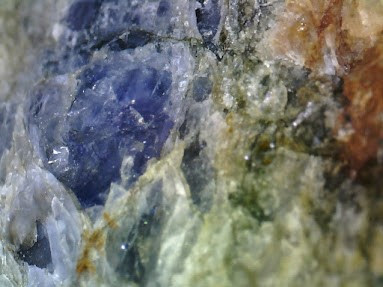
Cordierite. Width FOV ~7 mm.
|
Traditional garnet species
|
|
|
Different varieties of garnet. Figure accessed from from
MinDat.
Garnets are a group of silicate minerals that
have similar physical properties but different chemical compositions. All
varities have a hardness of ~6.5-7.7 (Mohs), commonly form as dodecahedrons or
cubic crystals, have a vitreous or subvitreous luster, a white streak, but
occur in a variety of colors with red, red brown, or green as dominat forms.
Garnets have been popular gemstones for centuries, and today are among the most
reasonablly priced faceted stones and are often set in silver rings, ear rings,
and pendants.
Garnets can form in a variety of
environments-igneous granites and pegmatites, metamorphic (both contact and
regional) rocks of almost all facies, and as detridal grains in sedimentary
rocks or unconsolidated sediments. However, garnets are commonly found in
schists and gneisses that formed in regionally metamorphic environments—as one
observes in the metamorphic rocks in Custer County. Most of these garnets in
the county are almandine (Fe2+3Al2Si3O12).
These garnets are the iron-rich end member of a solid-solution series with
pyrope garnets having magnesium substituting for the iron.
West of Custer about 6-7 miles are exposures of a micaceous schist
containing tiny “gemmy, transparent, ruby-red modified dodecahedral crystals of
almandite [almandine garnets]” Fe3Al2(SiO4)3
(Roberts and Rapp, 1965).
Staurolite is a higher-grade metamorphic mineral that
usually requires more heat than garnets. Redden, in his mapping of the Berne Quadrangle
(1968) was able to map the staurolite isograde as the rocks moved closer to the
heat source, the Harney Peak Granite.
Staurolite crystals in a micaceous schist west of Custer in the
Amphibolite Zone. Width FOV ~9 cm.
A large badly fractured crystal of staurolite in a micaceous garnet-biotite
schist, Amphibolite Grade, collected near the Custer-Pennington County line on
US 16. Width FOV ~7 cm.
Staurolite [Fe2+2Al9Si4O23(OH)]
is another of those iron aluminum silicates that results from relatively high-grade
metamorphism of aluminum-rich argillaceous sedimentary rocks. Euhedral crystals
are dark brown to brownish black to reddish-brown in color with a white streak
and somewhat hard at 7.0+ (Mohs). Staurolite is best known for its 60 degrees
twins. The mineral is common in schists found in the Black Hills. I really don’t
remember where the micaceous schist specimen of staurolite came from except in
the Berne Quadrangle west of Custer.
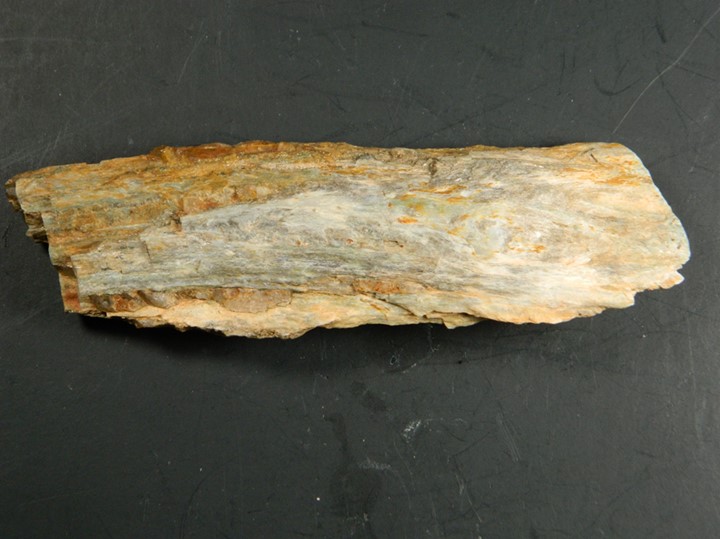
Sillimanite [Al2SiO5] is a mineral
that I had never observed in the field until I reached the Black Hills. In
several localities in Custer and Pennington Counties sillimanite is associated
with variable pressure and high temperature in rocks close to the Harney Peak
Batholith (see Chart). It is a rather strange mineral, at least in specimens I
have observed. It occurs in pods or ellipsoids or knots that are most notable when
they weather out of micaceous schists. These pods are usually white or dirty
white, sort of fibrous and splintery, brittle, and thin layered, and come in a
variety of sizes. Hardness comes in at
~6.5-7.5 (Mohs) and the streak is white and the luster silky. It is one of the
polymorphs of kyanite and andalusite (see Phase Diagram above).
Sillimanite pod, obverse and reverse views. Length ~9 cm.
A somewhat forgotten, and rather rare, mineral in the Black
Hills is scapolite. It is a silicate but is not really an individual mineral
but a solid solution series between end members marialite (sodium chloride
rich) and meionite (calcium carbonate rich): Na4Al3Si9O24Cl
to Ca4Al6Si6O24CO3.
The sodium and calcium are interchangeable with each other as are the chlorine
and the carbonate radical, therefore leaving an infinite number of chemical
compositions. In addition, calcium may include some strontium while the sodium
may include potassium. And SO4 may substitute for some CO3
(Evans and others, 1969). It appears that “pure” end members never occur
in nature so intermediate compositions are the norm; however, these
intermediate members vary considerably in chemical composition and remain
unnamed. Members of the solid solution series are essentially
indistinguishable (visual) from each other and therefore scapolite is
simply used for all.
Scapolite comes in a variety of spectral colors ranging
from colorless to white and yellow, purple, blue, red, green, pink, brown,
gray, orange and various mixed compositions. However, all varieties have
a white streak. The transparency ranges from completely opaque to translucent
to completely transparent while the luster ranges from vitreous to dull and
pearly. As scapolite weathers to “mica” the luster becomes dull, and the
diaphaneity becomes opaque. The hardness of ~5.5-6.0 (Mohs) makes gemmy
varieties more suitable for pendants rather than rings. Scapolite
crystals are Tetragonal and generally come in two distinct forms: short and
fat, or long and prismatic.
Scapolite is a rare mineral in the Hills with almost all larger
specimens coming from the Susan Lode located about five miles east- northeast
of Custer although Roberts and Rapps (1965) noted small grains are found in the
amphibolite facies west of Custer.
The Susan Lode is an enigma, at least to me. I simply cannot locate information about any
mining or minerals, virtually nothing except limited material on MinDat and Roberts
and Rapp (1965). The most detailed
description of the Susan Lode seems to be in an unpublished BS thesis at SDSMT,
a copy seems unavailable, at least to me (hundreds of miles away from Rapid
City).
Partial crystals of striated scapolite. Width FOV ~5 cm.
Roberts and Rapp (1965) state: “scapolite,,,occurs in great
abundance along the contact between a Precambrian metasedimentary xenolith and [the
Harney Peak] granite at the Susan Lode.” The color of the mineral varies and
crystals are usually long prismatic, coarse, and vertically striated. So, these
minerals seem to be the result of contact metamorphism due to heat from the
granite affecting the metamorphic rocks. Best guess that I can make.
The metamorphic rocks of the Black Hills contain many more
minerals than those listed here. My simple goal was to briefly describe a few
minerals that are indicators of metamorphic temperature and pressure in the
rocks west of Custer. Interested readers should consult the detailed maps
completed by Redden and Dewitt, especially the Berne, Custer, and Fourmile Quadrangles
as well as the Redden and Dewitt large scale Black Hills map.
REFERENCES CITED
Evans, B.W., D.M. Shaw, and D.R. Haughton, 1969, Scapolite
stoichiometry: Contributions to Mineralogy and Petrology, v. 24, issue 4.
Redden, J.A.,
1968, Geology of the Berne Quadrangle Black Hills South Dakota: U. S.
Geological Survey Professional Paper 297-F.
Redden, J.A., and
DeWitt, Ed, 2008, Maps showing geology, structure, and geophysics of the
central Black Hills, South Dakota: U.S. Geological Survey Scientific
Investigations Map 2777, 44-p. pamphlet, 2 sheets.
Roberts, W.L. and
G. Rapp Jr., Mineralogy of the Black Hills: South Dakota School of Mines and
Technology Bulletin 18, Rapid City.