Thursday, July 8, 2021

BROOKSELLA & AGATES--- COULEE ROCK SHOW; LA CROSSE, WISCONSIN

 It was a great day in La Crosse and I was ready to go, large coffee in hand.  The Coulee Rock Club did an outstanding job,  Congratulations.

The Onalaska Omni Center is a great place for smaller venues.

In my last posting I described my happiness is being able to wander around a spring edition (May 23-21) of the RMAG Promotions spring show at the Denver Crown Plaza Airport Convention Center.  It was really nice to buy a few minerals and take tantalizing peeks at some really fine specimens out of my price range.  But then my excitement really soared when I discovered that a trip to my ole stomping grounds of La Crosse, Wisconsin, coincided with the annual show of the Coulee Rock Club.  I was aware the show existed due to a couple of lectures at past shows; however, the coinciding dates was pure serendipity. Although small in members, the club has an outstanding and impressive cadre of show organizers and workers.  Their show was held on a two-day weekend (June 4-5) in a great venue—the Onalaska Omni Center. Dealers, along with Club activities for juniors/pebble pups/children, occupied most of the space. 

Kiddies, spin the wheel.
 

Although flint knapping was not participatory it attracted a large crowd of youngsters all day--watching in awe.

However, the Club did leave room for perhaps the most popular show event, the Silent Auction.  A long table held perhaps 15-20 stations that were changed on a regular rotation and successful bidders were quite pleased with their purchases--especially the younger members (who are the future members of our clubs).  I was actually amazed at the variety of items open for bidding with a number of different well-preserved early Paleozoic fossils that would give any kid a good start on a personal fossil collection.  In addition, there were a number of minerals, some well crystallized, from numerous states and a few foreign countries (but also unlabeled as to origin).  A few minerals had some old and quite fragile identification cards.  In other words, something for everyone, especially the younger rockhounds. 


I picked up an item or two, especially if bids were not coming in on a regular basis. I soon parted with the purchases by gifting to younger rockhounds who could not attend the Show:


Geodes and calcite crystals to grade school rockhounds.


Unfortunately this coiled Cretaceous ammonite (Placenticeras) was incomplete but had a beautiful display of suture lines.  My best guess is the critter was collected from the Pierre Shale (pretty certain) from South Dakota, perhaps Wyoming. Goes to an adult fossil hound.

OK, we don't need to know about locality information on this trilobite from a dealer.  My guess is Morocco 😁😁😁 Is there any reconstruction???

Crinoids are much more common at Midwest shows that in the West.  But no locality information!
All gars (Fish) have "lots of" sharp teeth.  Here is a saber tooth gar
.  No locality infornation.
Mineral specimens were sparse. Kyanite.
Sulfur.  Hard to tell if it was made last week or "long ago".  No information on locality or age. 

THE KEEPERS: 1) a visit with Doug Moore, formally with the University of Wisconsin System--biologist, but now one of the premier agate collectors and photographers in the country (HQ at Stevens Point, WI).  Doug had for sale a fantastic variety of agates, mostly Lake Superior and Fairburn.  He also sells some of his majestic photographs (my poster is at the framer so the photos below are substitutes).


Thin slice of Dryhead Agate. Nabbed from Pinterest.com. 


Photo from Art Gala night at 2016 Agate Expo.

THE KEEPERS: 2) I picked up an interesting circular "glob" of reddish-orange sandstone (~10 cm x 12 cm). It was pretty ugly and no one topped my bid of a buck.  I though it was an internal mold of a Cambrian jellyfish although it came without much information (zoophycos).  But a little research indicated that it was not a Cambrian jellyfish (although I was in good company as the famous paleontologist Charles Walcott (1896, 1898), he of Burgess Shale fame, described them as fossil medusa [the free swimming life cycle] of Cnidarians--the corals and jellyfish). That is interpretation number 2.

What I came up with my search was an enigmatic critter (or is it a critter) named Brooksella, that are collected from the Cambrian Conasauga Formation of the Coosa River Valley of Alabama and Georgia. They are known as star cobbles due to their lobate structure (3-15 lobes). Ciampaglio and others (2006) described  the morphology of Brooksella as most consistent with a siliceous (hexactinellid) sponge. So that is interpretation number two, a fossil sponge.

Now here comes interpretation number three, a non critter! Nolan and others (2016) examined a number of specimens and determined that "Brooksella’s composition and internal structure are similar to concretions from the Conasauga: quartz grains with minor amounts of calcite and small, oxidized, root-like holes partly filled with iron oxide and barite crystals. In situ Brooksella were rare and were oriented with their “oscula” and lobes downward, rather than upward if this was a once-living sponge. Furthermore, shale laminations were displaced by the growth of the putative sponge. We therefore think that the sponge designation is insufficiently supported, and we favor a concretional mode of formation for Brooksella."

What does all this mean? The popular literature seems to favor sponges.  In summary I really like the following from the web site of The Paleontological Research Institution (www.priweb.org.) They note that "texts and images on this website have Creative Commons-NonCommercial ShareAlike 4.0 International licenses."  I thank them for the right to copy and redistribute the material.

Shales and concretions in the middle Cambrian Conasauga Formation of northeastern Alabama and northwestern Georgia contain body and trace fossils showing the preservation of diverse soft-bodied organisms, as well as many mineralized skeletons. These include algae, sponges, arthropods, brachiopods, echinoderms, mollusks, and trace fossils. Some of the most curious Conasauga fossils are "star cobbles," referred to the genus Brooksella. These enigmatic fossils have been variously thought of as medusae (jellyfi sh), algae, trace fossils, or inorganic structures. Recent research suggests, however, that they are most likely sponges with siliceous (SiO2) skeletons.
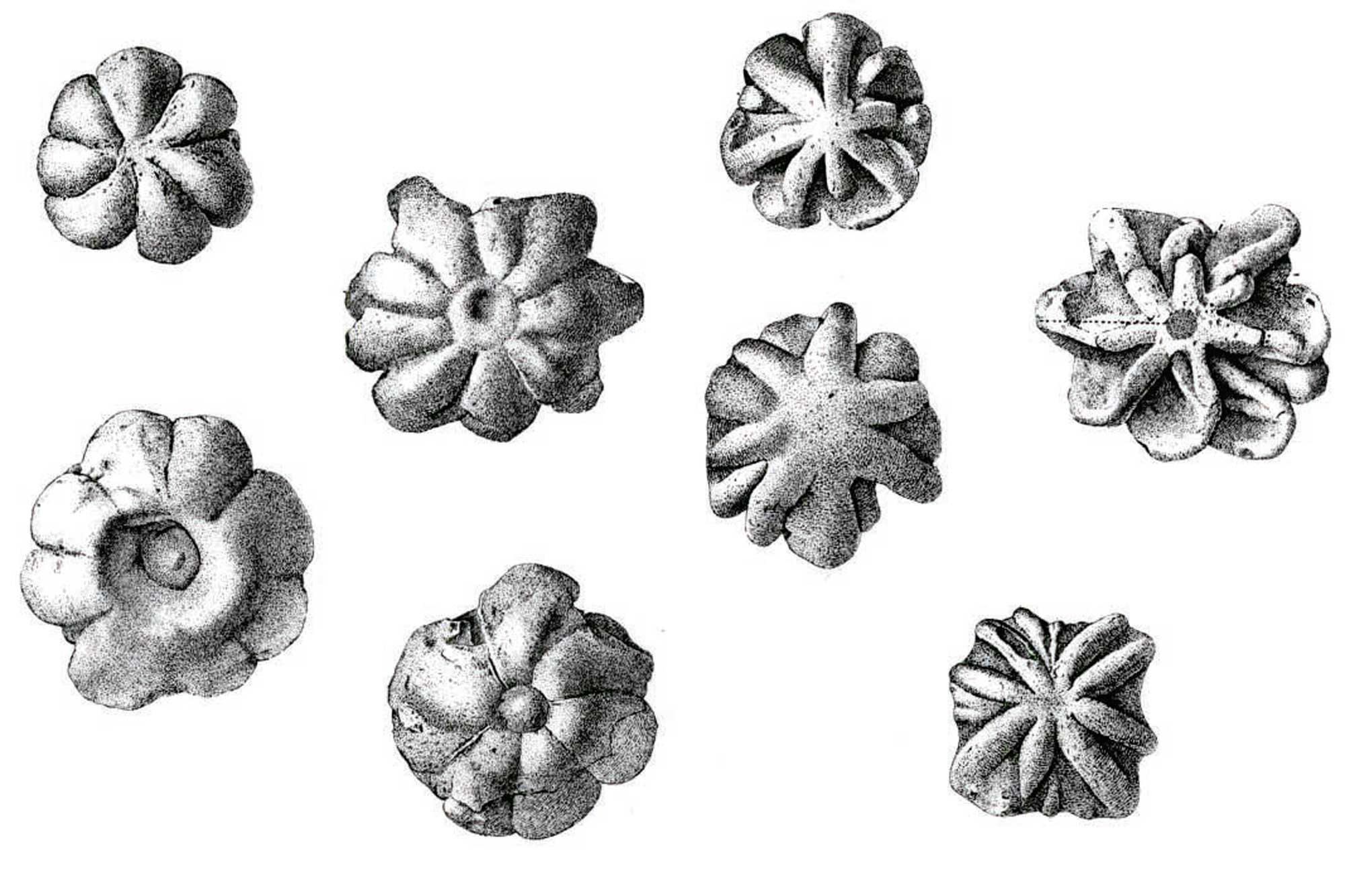

Image

"Star cobbles" (Brooksella) from the Cambrian Conasauga Formation. Fossils are 2.5–centimeters (1–2 inches) across. Images from Walcott (1898; Monographs of the U.S.G.S, 30); public domain

REFERENCES CITED

 Ciampaglio, C.N., L.E. Babcock, C.L. Wellman, A.R. York, & H.K. Brunswick. 2006. Phylogenetic affinities and taphonomy of Brooksella from the Cambrian of Georgia and Alabama, USA. Palaeoworld 15: 256-265.

Ciampaglio, C.N., C. Wellman, H. Brunswick, A. York & L.E. Babcock. 2005. Reinterpretation of Brooksella from the Conasauga Formation (Cambrian) of Georgia and Alabama, USA. in The Fourth International Symposium on the Cambrian System and the Tenth Field Conference of the Cambrian Stage Subdivision Working Group, Nanjing, August 18-24, 2005, abstracts and short papers. Acta Micropalaeontologica Sinica 22(Supplement): 21-23.

Ciampaglio, C.N. & L.E. Babcock. 2006. Reinterpretation of Brooksella from the Conasauga Formation (Cambrian) of Georgia and Alabama, USA. Geological Society of America Abstracts with Programs 38(3): 4-5.

Nolan, Morrison, S.Walker, & A. Sharma, Ajay. 2016. RE-EVALUATION OF THE MIDDLE CAMBRIAN SPONGE, BROOKSELLA ALTERNATA , FROM THE CONASAUGA FORMATION, GEORGIA AND ALABAMA, U.S.A. Geological Society of America Abstracts with Programs 48 (7). 

Walcott, Charles. 1896. Fossil jelly fishes from the Middle Cambrian terrane: Proceedings of the United States National Museum. 18 (1086). 

Walcott, Charles. 1898. Fossil Medusae: Monographs of the United States Geological Survey. 30.


Tuesday, July 6, 2021

DENVER SPRING SHOW WITH EOSPHORITE & COLLINSITE


He meant the Grand Canyon was only a mood of nature, a bold promise, a beautiful record. He meant that mountains had sifted away in its dust, yet the canyon was young. Man was nothing, so let him be humble. This cataclysm of the earth, this playground of a river was not inscrutable; it was only inevitable—as inevitable as nature herself. Millions of years in the bygone ages it had lain serene under a half moon; it would bask silent under a rayless sun, in the onward edge of time.    Zane Grey


On the way home from the Tucson Re Do I stopped in to ogle at a really magnificent, awe inspiring, deep canyon!    

21-23 May 2021 Denver Colorado Mineral and Fossil Spring Show

When I saw the headline shown above I started doing cartwheels, well not really gymnastic cartwheels but a little fast shuffle.  Was it really true?  Were the rock and mineral shows coming back on line?  I had just attended a couple of days of a shortened show schedule in Tucson, the April Re Do (see previous postings), but was delighted to see that an event was slated close to Colorado Springs.  Furthermore, our local rock and mineral club, CSMS, rescheduled their annual show from June to October.  Things were looking up.  The 2021 Rocky Mountain Federation event in Las Vegas was postponed until 2022; however, the Sublette County Rockhounds in Big Piney, Wyoming, jumped in and volunteered to host the 2021 RMFMS and the American Federation meeting and shows June 16-20.  I expect a large crowd as rockhounds want to escape to the country.

But back to the Denver Show.  This event was sponsored by a private promoter (RMAG Promotions) and is not to be confused with the annual fall showcase sponsored by a consortium of local Denver area rock and mineral clubs.  The  event was held at the Crowne Plaza Denver Airport Convention Center. A really good couple of points: parking was free and space inside the center was more than adequate.  A not so good point: I-70 and I-35 are still undergoing major construction and traffic was fouled.

A substantial number of dealers were present but I don't have the exact count--more than 50 but less than a hundred  I would guess! It seemed to me that: 1) loose cabs and some faceted stones were abundant; 2) mineral specimens and crystals were less common and scarce and those present were the common types; 3: jewelry with nice gemstones was rather rare although bead necklaces were common.  With those observations in mind I would say that the show was geared towards: 1) the general public (non rockhounds); and lapidaries looking for raw specimens.  Whatever the case, I enjoyed the displays and hope the show was successful.  And, I did come home with a few treasures!


The main hall for the dealers had plenty of room.  In addition there was a smaller space for wholesale dealers.

+ 

Signs that warm my heart: $5 minerals and 50% off!


What would a rock and mineral show be without Brazilian amethyst geodes? However, the big towers were lacking.


A few fossils were found but mostly of the common varieties.

Donald K. Olson had some nice minerals, especially sulfur crystals.

A well curated collection collection of Phil Persson (Persson Fine Minerals) out of Denver.


Show staples---beads and bead necklaces.


New Era Gems had a great display of gemmy tanzanite; some treated to deepen color, some natural.


Dennis Beals of Denver displays at numerous show across the country.

One of the interesting specimens I picked up at the Show was collinsite with eosphorite collected from Lavra da Ilha, near Taquaral, Minas Gerais, Brazil, and ex Alfred Stevenson collection.  Two things about this statement: 1) I did not recognize the collector, Alfred Stevenson.  However, I did find that Mr. Stevenson was born in 1916 and died in 2007 in New York and was an active rockhounder.  Evidently Mr. Stevenson amassed a large collection since his specimens have been, or are, for sale via a wide variety of mineral auctions. 2) I did not recognize the Brazilian collecting locality (not surprising) but did find a really interesting group of mineral articles in the Free Library (see References Cited).  In one article Guido Steger said this about the locality:  When in Brazil I often ask hopefully about the possibility of specimens from the Lavra da Ilha, near Taquaral. In the early 1970's, wonderful specimens of rose quartz crystals from Lavra da Ilha created a sensation. The coxcomb-like arrangement of the crystals, combined with their pale to deep rose-pink color, makes these unusual specimens very appealing. In some cases a white or clear quartz crystal is garlanded by the rose quartz crystals. Two commonly associated species are eosphorite-childrenite, in well-formed, transparent crystal aggregates…

The locality is on a little island in the Jequitinhonha River which is flooded most of the time. When the water is low--only a few weeks out of the year--the digging site is exposed, and then the owner can try to extract the elusive rose quartz crystals, which are rare and are highly valued as gemstones.

Unfortunately major finds had grown rare by the early 1980's, and top-quality specimens almost vanished from the market. The island may be reached from Taquaral, a very small village between Itaobim and Aracuai, in Minas Gerais.

Eosphorite is a member of my favorite group, the phosphates (containing the PO4  Ion—a central phosphorous atom surrounded in a tetrahedral arrangement by 4 oxygen atoms),  that often seem to turn up at rock and mineral shows and immediately attract my attention.  The mineral is a hydrous manganese aluminum phosphate [MnAl(PO4)(OH)2-H2O) that forms long, more stout than slender, prismatic crystals that usually appear as radiating clusters. Crystals are usually some shade of brown in color but are sometimes pink or reddish.  They are “shiny” on the surface but somewhat less than vitreous—a subvitreous luster on the exterior.  Broken crystals often have a vitreous light amber color on the interior.  Depending on the color, crystals range from transparent to translucent.  They leave a white streak and have a measured hardness of ~5.0 (Mohs).  In my specimen most crystals show a wedge shape termination.


Spray of eosphorite crystals; width of spray ~1.0 cm.

Different camera angles of above spray.
Scattered eosphorite scattered and embedded in collinsite.

Eosphorite is in a solid solution series with childrenite where iron (Fe++) substitutes for the manganese (and many writers use eosphorite-childrenite for specimen ID).  I don’t believe there are formal “middle members” of the series and eosphorite is Monoclinic while childrenite is Orthorhombic (Crystal Systems).

Eosphorite is associated with other secondary phosphates in granite pegmatites, often lithium-rich forms, where primary phosphate minerals are available as precursors for the colorful secondary forms.  The famous Tip Top Mine in Custer County, South Dakota (Black Hills) has both eosphorite and collinsite present.

Speaking of collinsite, the second group of crystals on my specimen is labeled as such; however, I am somewhat bothered by the fact that the single photo in MinDat from the Brazilian locality does not “look much like” my specimen.  But….the morphological descriptions of collinsite, and the photos from the Tip Top Mine and the Rapid Creek area in the Yukon, Canada, seem to match this specimen.  I need to have Tom Loomis up at Dakota Matrix take a peek.


White to yellow while crystals of collinsite (with scattered brown eosphorite crystals).  Width pf photomicrographs ~1.0 cm).

Collinsite is a hydrated calcium magnesium phosphate [Ca2Mg(PO4)2-H2O] that is often brown in color but can range to colorless, black, white, pale blue or yellowish white.  It is translucent with a white streak and a hardness (Mohs) of 3.0+.  It has a silky luster and crystals are commonly bladed to prismatic (at times globular masses or fibrous).  Superficially it reminds me of fairfieldite (hydrated calcium manganese phosphate—see Posting Dec. 14, 2020)   in which it forms a solid solution series.  In other words, it looks like many other secondary phosphates.  Like most of these minerals it is a secondary weathering product with a primary phosphate precursor(s).

So, this has been a quick summary of the 2021 Denver Spring Show.  It was an enjoyable day in which to look at minerals and talk to the dealers.  I look forward to the summer shows.

REFERENCES CITED

Guido Steger  Memoirs of a mineral collector--Part 2: fifty-nine treasure hunts in Minas Gerais, 1969-2005.. (n.d.) >The Free Library. (2014). Retrieved Jun 29 2021 from https://www.thefreelibrary.com/Memoirs+of+a+mineral+collector--Part+2%3a+fifty-nine+treasure+hunts+in...-a0147065816


Tuesday, June 29, 2021

AFMS & RMFMS ANNUAL SHOW AND CONVENTION, BIG PINEY, WYOMING, JUNE 2021: PART TWO

 This second blurb represents my annual report to:

ROCKY MOUNTAIN FEDERATION OF MINERALOGICAL SOCIETIES PUBLIC LANDS (PLAC) REPORTS 2020-21

MANAGEMENT OF PUBLIC LANDS IS OFTEN A CONTENTIOUS ISSUE.  THE INFORMATION SUPPLIED BELOW IS MY PERSONAL OPINION AND REPORT AS A COMMITTEE/STATE CHAIR.  IT DOES NOT NECESSARLY REPRESENT THE OPINION OF CSMS NOR THE RMFMS.

This his has been an interesting year to say the least. All rockhounds have probably suffered from the effects of the pandemic, perhaps not being ill but suffering due to cancellation of club meetings, shows, other monthly events.  I suspect club memberships have declined and certainly the lack of shows has hurt the budgets.  However, clubs have become quite innovative in trying to keep the members together.  CSMS dropped the membership fees for returning members in 2021, as have several other clubs.  Then amazingly a computer program called Zoom suddenly appeared on the market and not only were companies signing in to Zoom in lieu of business travel, rock and mineral clubs found a way to hold monthly meetings and symposia.  My first attended symposium was in October 2020 when I Zoomed into the annual Desaultels Micromount Symposium held in Baltimore, Maryland; one Hall of Fame awardee gave his talk from a computer in Italy.  I also listened, via cell phone when traveling, to the 2020 AFMS meeting.   Now “Zooming” seems a standard mode of operation.

However, trying to interpret what is going on in the public land arena is much more difficult than Zooming to a club meeting!  This difficulty is more due to a change in administration on the national level than the pandemic. In 2020 it appeared that the energy industry was in charge of public lands while rockhounds and small claim owners were drawing the short straw. One never really knew who had authority over parcels of Federal land!  Was it being “claimed” by the energy industry or could rockhounds actually get on the land and collect?  It was really tough to locate the truth and fully understand what was going on with USFS and the BLM. In addition, the hard working, local, federal employees simply were not getting appropriate information coming down the line. Currently land managers are waiting to learn how a new administration handles public lands.  In my humble opinion there will be less emphasis on opening lands to mineral and energy exploration, and more emphasis on preserving public lands for the people.  Now the big question: what is the place of public recreation on federally managed, and to a lesser extent, state lands?  I view the glass as half full while some of my colleagues view it as half empty and note that rockhounding on federal lands will disappear.  As an optimist I believe rockhounds now have a great opportunity to convince land managers that we are the “good persons” and will be thrilled to work on developing land use policies with a conservation ethos.  Instead of declaring rockhounding on the verge of extinction, I have written the Secretary of Interior, and some of her ranking subordinates, explaining what rockhounds really do when collecting on federal lands.  We are not the persons destroying landscapes, knocking down fences, leaving tire tracks in the mountain tundra, and digging unfilled holes.  Yes, those sorts of things occur with renegade rock and mineral collectors, those looking for a quick profit in the selling of minerals; however, most destruction is caused by persons who have little regard for public lands and view such lands as their personal playground to desecrate in whatever manner they chose.  I have fixed broken fences, and our local club (and most others) are constantly filling holes dug by claim jumpers.  Most clubs have a rule---fill a hole left behind before prospecting.  Shirley Leeson (CA) was a leader in working with BLM to clear trash near Quartzite. And importantly, rockhounds must stay on approved BLM and USFS roads.  Write your congressional members and local federal land managers.  Volunteer to help with decision making about the appropriate land usage.

Two years ago then President Trump signed into law the John D. Dingell Jr. Conservation, Management, and Recreation Act (S.47, the Dingell Act). The Act was heralded as the single most important and wide-ranging public lands management law to be passed with bipartisan support in over a decade. The Act: • Encompassed more than 100 individual bills; • Permanently reauthorized the Land and Water Conservation Fund; • Created new Federal authorities to assist the Department in managing endangered and invasive species; • Called for increasing access to public lands for hunting, fishing, and recreational shooting; and • Advanced a wide variety of conservation and recreation initiatives for the American people. I had great hopes that the Act would at least rank rockhounding up there with recreational shooting; however, rockhounding did not even get a mention anywhere in the Act (we do not have a strong congressional lobby).  In addition, Interior found ways to skirt certain portions of the Act to benefit persons/companies other than rockhounds. But there may be a ray of light in the Act---it noted that the Secretary shall administer [certain Federal areas] in accordance with the laws generally applicable to the National Forest System. I believe, at last count, that the USFS allows collecting of rocks and minerals with a free use permit, or sometimes without a permit. The big problem is that the USFS (in my opinion) has not formalized any sort of National Forest collecting regulations.  The National and Regional offices, as best I can determine, have left regulations to individual Forests and that has left a state of confusion among collectors.  So, it is critical that rockhounds contact individual Forests for information about collecting. 

Rockhounds first need to examine Forest websites and if they disagree with  regulations, have this information in hand before a personal visit to the office. Collecting fossils is another area of confusion. Collecting of vertebrate fossils on any Federal land is not allowed without a formal permit (essentially you work for a museum and will deposit such collected fossils in a federally approved repository).  Collecting invertebrate fossils on USFS land is, as my mother used to say, a bag of worms.  I have written several articles on collecting of invertebrate fossils and I don’t need to repeat such words in this report.  A fossil collector really needs to visit with the USFS local office to understand what they consider critical fossils or common fossils, and ground disturbance, and shovel size, and the need for a permit, etc.  Formalized regulations of collecting invertebrates on BLM land is essentially “on hold.”  However, make certain to visit BLM websites since many/most offices have decided to construct their own rules but most are not as onerous as the USFS regulations.  Just be nice to the local offices since most workers are as confused as the collectors.  But, you should know details about federal laws and be able to present such if questioned by personnel. 

Last year I spent much time trying to decipher the Dingell Act (try reading the Federal Register before bedtime!!!). This year I am still trying to understand The National Defense Authorization Act that was passed in December 2020 over a then President Trump veto (this bill was mostly in the news due to renaming of military bases). At first glance I was interested in the section on money laundering and antiquities but then decided that the government’s definition of antiquities does not include fossils.  The bill originally included some important proposals regarding public lands. One of these land prioriites was found in Senate 823, the "Colorado Outdoor Recreation and Economy (CORE) Act," which would guarantee the state about 73,000 acres in newly designated wilderness and around 80,000 acres of new recreation and conservation management areas. This section failed to pass due to concerns about the bill's prohibition on new oil and gas development on Colorado's Thompson Divide.

Another conservation priority, the "Protecting America's Wilderness Act," was also not included in the NDAA final bill. The legislation, House Resolution 2546, was a package of six individual bills crafted to protect nearly 1.3 million acres of wilderness and designate more than 1,000 miles of rivers across Colorado, California, and Washington state.  Negotiators also did not approve a House provision that would have permanently banned new mining claims around Grand Canyon National Park.  However, President Biden has endorsed the continued ban on the mining (uranium).Then there is the continued confusion about Grand Staircase Escalante & Bears Ears National Monuments.  Most remember that former President Trump greatly reduced the size of both monuments and created a firestorm. Currently, President Biden has commissioned a committee to examine the issue, and in my opinion, will probably restore the monuments to near the original size. About a year ago a new BLM management plan restored the public’s right to collect rocks, minerals and common non-vertebrate fossils in the land removed from the Grand Staircase Monument (essentially what collecting is normal for BLM land).  If the monument is restored to original size, will these collecting rights disappear?  I suspect they will fall by the wayside. Collecting has never been allowed on Bears Ears National Monument.

In my personal opinion, the collecting of rocks and minerals in this area of the country, call it Four Corners Region, (mostly varieties of silica) has been confused with collecting of Native American artifacts---everything has been lumped together.  If a rockhound was out collecting jasper would they pick up an “arrowhead”?  I can’t answer that question; therefore, it is much easier to simply ban all collecting.  Rockhounds are also often lumped with renegade OHV riders and get blamed for creating new trails.  Rockhounds do not have any sort of a congressional/land manager lobby and therefore, very few decision makers know much about our hobby, nor do they really care.  I certainly don’t have answers to my many questions.  But again, I suggest rockhounds continue to contact land managers and congressional delegations

AFMS & RMFMS ANNUAL SHOW AND CONVENTION, BIG PINEY, WYOMING, JUNE 2021


ROCKY MOUNTAIN FEDERATION OF MINERALOGICAL SOCIETIES INTERNATIONAL RELATIONS COMMITTEE REPORT 2020-21

This little blurb was submitted to the RMFMS at Big Piney, Wyoming, June 24th, 2021

This has been an extra quiet year for the International Relations Committee (membership of one), a really quiet year!  However, I still get a few questions about “international things” but suspect that most inquirers locate an email address from my Blog rather than the RMFMS website. But that is OK as I enjoy trying to answer questions. It seems every year, especially after the Tucson shows are over, a couple of rockhounds ask for information about collecting ammolite from the Cretaceous Bearpaw Shale cropping out near Lethbridge, Alberta, Canada. I suspect they have seen the beautiful specimens for sale at Tucson and are interested in self collecting. I refer them to a previous article in my Blog about collecting ammolite and the short answer is don’t try it, just visit Korite International and buy it. This year I have also remined people that I can/could not get into Canada for fishing due to Covid restrictions, so there was/is not much of a chance for rockhounds crossing the border. The Rockhounds discussion group on the web has several international members who certainly bring an interesting collecting experience to the group. Members are quite helpful to anyone posing a question about geology, rocks, minerals, and fossils.

 I often (at least once a month) receive an inquiry from an international rockhound that states something like “I purchased this specimen (photo enclosed) at a mineral show/dealer but the only listed locality is INSERT STATE. Can you help me locate the locality?”  That is sort of a hit and miss situation from a soft rock stratigrapher like me---but I give it my best shot. With the pandemic and travel restrictions in full swing I also receive requests from international rockhounds wanting to send or trade minerals. I usually ask what sort of mineral they are looking for and then suggest a contact with an appropriate club.

One of the really great things to evolve from the pandemic is Mineral Talks-Live, a joint venture by Blue Cap Productions (Bryan Swboda), the Mineralogical and Geological Museum, Harvard University (Raquel Alonso-Perez), and the Society of Mineral Museum Professionals (Eloise Gaillou). “This series was created as a response to the COVID-19 situation that has been greatly affecting the mineral world by isolating and separating us.”  The series is now in week 40+ and features a rockhound, dealer, mineralogist, designer etc. each week for an entertaining discussion and show and tell.  The audience is varied and includes many international participants—for example Dr. Gaillou “broadcasts” from Paris. All of the past shows are available on the You Tube web site.  I would encourage RMFMS members to “tune in” every Wednesday at 1:00 p.m. Eastern and get a new prospective on international collecting and museums.

And so it goes for the International Relations Committee. 

Addendum: as of June 2021  the shows have moved to one per month; see Blue Cap Productions for schedule.